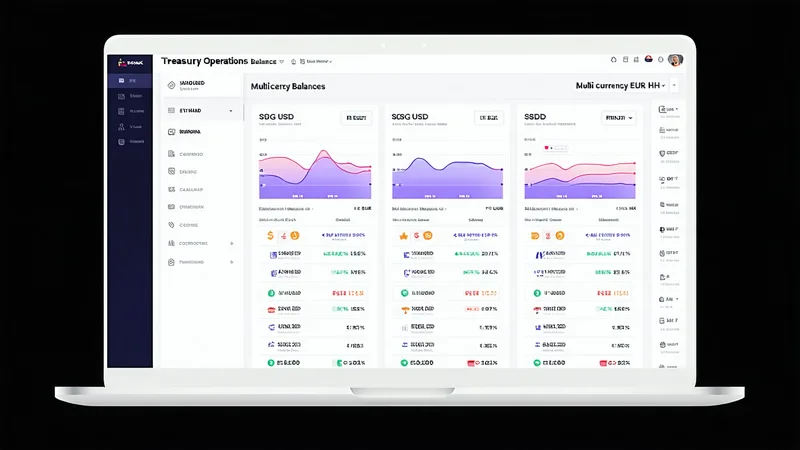
The default treasury behaviour for most Singapore SMBs with APAC operations is to convert foreign currency receipts to SGD as quickly as possible and to purchase foreign currency at the point of payment. This approach feels safe — it keeps the balance sheet in a single, familiar currency — but it is quietly expensive. Every conversion carries a spread, typically 1.5–3% over mid-market at the retail end of commercial banking. For a business doing SGD 2 million in annual APAC-currency transactions, that spread range translates to SGD 30,000–60,000 per year in avoidable conversion costs — a number large enough to employ a part-time finance manager.
Multi-currency treasury is not a sophisticated financial engineering concept. It is the practice of holding working balances in the currencies you actually use, converting at defined points rather than at every transaction, and structuring payment timing to reduce unnecessary round-trip conversions. This article covers the mechanics and the unit economics.
The Round-Trip Conversion Problem
Consider a Singapore SaaS company with Malaysian clients paying in MYR and Malaysian vendor costs also denominated in MYR. The company's bank receives MYR from clients, automatically converts to SGD, and later the company purchases MYR to pay vendors. Each conversion step carries a spread. The two spreads combined on a MYR 100,000 round trip at a 2% spread each way consume MYR 4,000 — approximately SGD 1,200 — in conversion costs on a flow that represents zero net currency exposure. The company is not managing currency risk; it is simply paying for unnecessary conversions.
A multi-currency wallet that holds MYR balances eliminates the round trip entirely for the portion of MYR inflows matched against MYR outflows. The retained balance acts as a natural hedge while the conversion cost drops to zero for the matched portion. Only the net surplus (MYR inflows exceeding MYR outflows) needs to be converted to SGD, and only once.
This is a straightforward efficiency, not a hedging strategy in the formal sense. We are not saying businesses should hold indefinitely large foreign currency balances to avoid conversion — unhedged balance accumulation is currency risk, not treasury management. The goal is to hold working balances sized to match known near-term payment obligations, reducing conversion frequency without taking speculative currency positions.
Sizing Multi-Currency Balances: The Coverage Ratio Framework
For each currency you operate in, the optimal balance to hold is roughly 4–6 weeks of expected outflows in that currency, adjusted for settlement timing on inflows. This coverage ratio gives you enough buffer to smooth payment timing without accumulating speculative long positions.
For a business paying Philippine contractors monthly in PHP, the right PHP balance is approximately 5–6 weeks of contractor costs — enough to ensure the month-end payroll disbursement is covered from the existing balance without requiring a spot conversion on the day payroll runs (when conversion urgency is highest and negotiating leverage is lowest). The balance gets replenished from PHP inflows if they exist, or from planned SGD-to-PHP conversions executed in non-urgent conditions.
For currencies where you have significant outflows but minimal inflows — a company paying Indonesian suppliers in IDR but receiving all revenue in SGD — the multi-currency balance still reduces conversion cost compared to transacting at spot each time, because you can plan conversions in advance and capture better rates on larger tranches than on small individual transaction-level conversions.
Conversion Timing: When to Convert
The single most actionable treasury improvement for most SMBs is not better hedging instruments — it is better conversion timing. Conversion timing means: converting currency when you have time and volume to negotiate a better rate, rather than converting under time pressure when payment is already due.
A treasury routine that works for businesses with SGD 200,000–1,000,000/month in APAC currency flows: review upcoming payment obligations weekly (or on a fixed schedule, e.g., every Monday). If outflows in a given currency exceed current balance, execute a conversion to top up the balance for the next 3–4 weeks of obligations. This approach concentrates conversions into larger, planned transactions rather than small, urgent ones — and larger transactions consistently achieve better rates than many small ones, because spread is partially a function of transaction size and urgency.
Which Currencies Warrant Dedicated Balances
Not every currency you touch warrants a standing multi-currency balance. The threshold question is: what is the monthly volume in this currency, and how frequently do you transact?
- MYR, PHP, INR, THB, IDR: For Singapore SMBs with ongoing APAC supplier or payroll exposure, any of these currencies above SGD 15,000/month in regular transactions likely justifies a standing balance. The conversion savings on that volume at typical retail spreads exceed the cost of the balance's administrative overhead within a few months.
- HKD, AUD, JPY: If these appear as one-off transaction currencies rather than regular operating flows, spot conversion at the time of payment is typically fine. The frequency is too low to justify maintaining an active balance.
- USD: Singapore businesses typically maintain USD balances regardless, given USD's role as the common denominator for many APAC commercial contracts. USD is usually already managed rather than defaulted to spot conversion.
Working with a Multi-Currency Payment Account
The operational enabler for multi-currency treasury is a payment account that allows you to hold, receive, and send in multiple currencies without automatic conversion. Traditional Singapore bank accounts convert foreign currency receipts to SGD by default. Multi-currency business accounts — offered by several licensed payment service providers in Singapore under the MAS PSA framework — hold each currency separately and only convert when you explicitly instruct a conversion.
When evaluating a multi-currency account for treasury purposes, the relevant questions are: which currencies are natively held (not just conversions made in those currencies); what are the conversion rates and spreads at each transaction size you expect to execute; are foreign currency balances safeguarded in segregated accounts (relevant under the PSA's safeguarding requirements); and does the account support local rail disbursement in destination markets, or does every outbound payment go via SWIFT regardless of the destination currency?
A Singapore manufacturing procurement firm with MYR 380,000 in monthly supplier payments and PHP 120,000 in monthly contractor disbursements ran both flows through a traditional Singapore bank in 2023, converting to each currency at the point of payment. After moving to a multi-currency account and planning conversions in weekly batches of MYR 90,000–100,000, the firm's average execution rate improved by roughly 0.6% against mid-market on MYR conversions — not because rates moved, but because planned, non-urgent conversion allowed them to select execution timing rather than paying whatever rate was available when payment was due.
Multi-Currency Treasury Is Not FX Speculation
Treasury teams sometimes resist holding multi-currency balances out of concern that it introduces currency risk. This concern is valid but often misapplied. Holding a MYR balance sized to cover the next four weeks of MYR supplier payments is not a currency position — it is working capital management in the correct currency. The currency risk of that balance is real but small, because the balance will be disbursed within 4–6 weeks anyway. The counterfactual (converting to SGD today and reconverting to MYR next month) actually creates more currency risk — two conversion events at unknown future rates — while also costing more in spreads.
The foreign currency balance that represents genuine speculative risk is one held beyond the operational horizon — balances sized in excess of known payment obligations and held with the intention of benefiting from a currency move. That is treasury speculation and outside scope for most SMBs. The working balances described in this article are categorically different: they are operational holdings sized to known obligations, held to reduce friction and cost rather than to take a currency view.
For Singapore SMBs whose APAC operations have grown to the point where multi-currency complexity is a real consideration, the first step is simply an honest accounting exercise: run a 12-month ledger of every FX conversion you executed, calculate what you paid in spreads versus mid-market, and stack that against what you would have paid with a managed multi-currency balance approach. The gap between those numbers is the annual opportunity in front of you.